
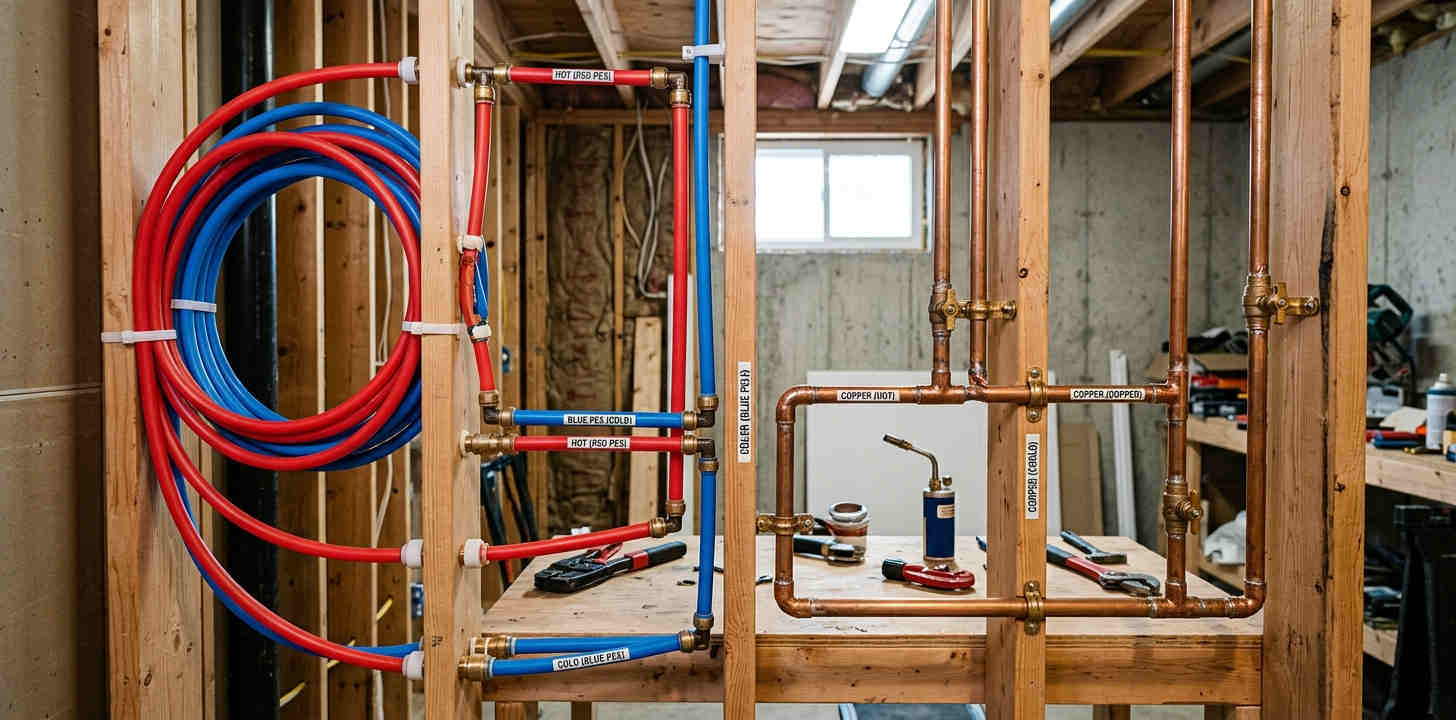
The Honest Answer
Neither PEX nor copper is categorically better. The right choice depends on project type, local pricing, installation crew familiarity, and sometimes local code requirements or owner preferences.
That said, PEX has become the dominant choice for new residential rough-in over the past decade — not because copper is inferior, but because PEX is faster to install, costs less in most markets, and performs reliably in residential applications.
Cost Comparison
Material cost: PEX tubing is consistently less expensive per linear foot than copper pipe. The gap varies by market and commodity prices, but typically PEX is 50–70% cheaper per foot.
Labor cost: PEX installations are generally faster than copper. No torch work, fewer fittings on curved runs, and faster connection methods (crimp, clamp, or expansion) reduce installation time. In labor-intensive residential projects, this is often more significant than material cost.
Total installed cost: PEX is typically 20–40% less expensive than copper for equivalent residential supply systems when both material and labor are factored in.
Installation Speed
PEX can be bent around corners without fittings (within radius limits), reducing the number of fittings and connection points on any given run. Home-run distribution systems using a manifold eliminate even more fitting points. Crimping and clamping are fast once crews are trained.
Copper requires fittings at every direction change and transition, plus soldering time and equipment. Experienced crews are fast, but the process is inherently more time-consuming than PEX.
Press-fit copper (using press fittings and a press tool) closes some of this speed gap — no torch work, fast connection — but still requires fittings at each change of direction.
Freeze Resistance
This is one of PEX’s real advantages over copper. PEX can expand when water freezes inside it and return to its original shape. Copper does not — it splits.
For projects in cold climates or with any exposure to freezing conditions (crawl spaces, exterior walls, vacation properties), PEX offers meaningful risk reduction.
Longevity and Reliability
Copper has a proven multi-decade track record in residential systems. Properly installed copper supply systems last 50+ years. The failure modes are well understood — corrosion under specific water chemistry conditions, pinhole leaks from aggressive water, and freeze damage.
PEX has a reliable track record since the 1990s in North America, with documented service life extending past 25–30 years in many installations. Failure modes include UV degradation (only relevant if exposed to sunlight), some fitting-related failures in early crimp systems, and chemical compatibility issues with certain hydronic fluids.
For standard residential potable water supply under normal water chemistry, both are appropriate choices.
Code and Approval Status
Both copper and PEX (Types A, B, and C) are accepted under UPC and IPC for residential potable water supply. Some local jurisdictions historically limited PEX use — this is increasingly rare but worth verifying before specifying.
PEX cannot be installed above-grade and exposed to UV (sunlight) without UV-resistant covering or shielding.
When to Choose Each
Choose PEX when:
- Cost and speed are priority
- Freeze resistance is a concern
- Home-run manifold distribution is preferred
- Crew is experienced with PEX installation
Choose copper when:
- Owner or architect specifies copper
- Local code requires copper in certain applications
- Project involves high-temperature or specialized applications outside standard PEX ratings
- Matching existing copper systems for additions or renovations
Product Note
Rough-In’s current catalog is focused on select plumbing and mechanical rough-in products. Contact Rough-In for current product information, document requests, and quote guidance.