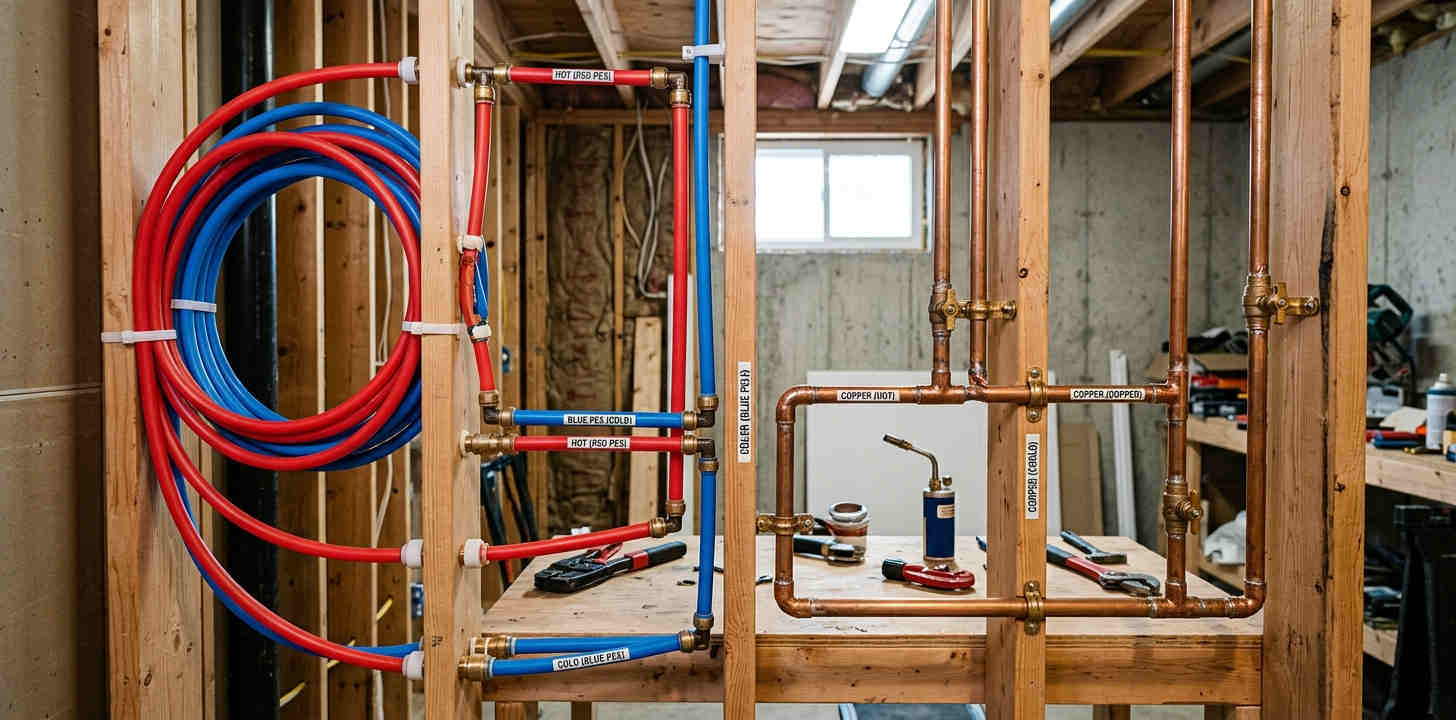
Spec sheets come in many formats, but the information that matters for plumbing system selection is fairly consistent across manufacturers. Understanding how to read a spec sheet saves time, prevents substitution errors, and avoids field failures.
The five fields that matter most
1. Pressure rating (and the test conditions behind it)
The pressure rating tells you the maximum operating pressure the product is designed to handle. But look carefully: many products list multiple pressure ratings depending on temperature and medium.
Common rating designations:
- WOG (Water, Oil, Gas) — the maximum pressure at ambient temperature for water, oil, or gas service
- CWP (Cold Water Pressure) — maximum pressure for cold water (typically 73°F)
- SWP (Steam Working Pressure) — relevant for high-temp applications; much lower than WOG
A 600 WOG ball valve can handle 600 psi at ambient — but may be rated for only 150 psi for hot water above 200°F. If you’re specifying for a high-temperature loop or a system with significant pressure swings, verify the rating at your operating temperature.
What to ask if the spec sheet is unclear: “What is the pressure-temperature derating curve for this product?”
2. Connection type and dimensional standard
The connection type tells you how the product joins to the rest of the system. This sounds obvious, but the failure mode is subtle: two products can share the same nominal size and still be dimensionally incompatible.
Common connection standards:
- Sweat (C×C) — copper tubing; ASME B16.22 dimensions
- Threaded (NPT/FIP/MIP) — tapered National Pipe Thread; ASME B1.20.1
- Press — proprietary profile; verify brand compatibility before mixing press systems
- Push-to-connect — check manufacturer approval for tubing type (copper, PEX, CPVC)
What to check: The listed standard (ASME, ASTM, ANSI). If a fitting is listed to ASME B16.22, its dimensions are interchangeable with any other ASME B16.22 sweat fitting of the same size. If it lists a proprietary standard, assume it is only compatible with that manufacturer’s system.
3. Material and wetted components
The body material is usually obvious. What matters for potable water is the wetted component material — the surfaces that contact the water.
Things to check:
- Lead content — NSF 372 (low-lead) or NSF 61-G certification required for potable water in most US jurisdictions. California AB 1953 applies in California
- Seat and seal materials — PTFE, EPDM, Buna-N, etc. affect chemical compatibility. Buna-N degrades in contact with petroleum-based oils; EPDM degrades in contact with petroleum distillates
- Dezincification resistance — for brass fittings in high-chloride water, look for “DZR brass” or “CR brass” designations
4. Certifications and listings
Certifications tell you which independent organizations have verified that the product performs as claimed and meets applicable standards. For plumbing products, the common US certifications are:
| Certification | What it covers |
|---|---|
| NSF/ANSI 61 | Potable water contact safety (no harmful leaching) |
| NSF/ANSI 372 | Lead-free content (≤0.25% weighted average) |
| UPC listed | Uniform Plumbing Code compliance (Western US) |
| IPC listed | International Plumbing Code compliance |
| cUPC listed | Canadian UPC equivalent |
| IAPMO | Testing organization for UPC/cUPC |
Most residential plumbing in the US requires NSF 61 and NSF 372 compliance. If a spec sheet doesn’t show these certifications, ask the manufacturer directly — the certification may exist but not be shown on the standard spec sheet.
5. Operating temperature range
Temperature affects pressure rating, material performance, and joint integrity.
- Maximum temperature — the upper limit for continuous service; short-term excursions above this accelerate degradation
- Minimum temperature — relevant for outdoor applications and freeze-exposure risk
- Thermal expansion — CPVC and PEX expand significantly more than copper; systems with long runs need expansion accommodation
For hot water supply: check the spec sheet at 140°F (domestic hot water setpoint) and at 180°F (Legionella prevention setpoint for some commercial systems).
Connection type quick reference
| System | Common connection types | Dimensional standard |
|---|---|---|
| Copper supply | Sweat (C×C), Press, Push-to-connect | ASME B16.22 (wrought), B16.18 (cast) |
| PEX-A supply | ProPEX expansion, crimp (F1807) | ASTM F1960, F1807 |
| PEX-B/C supply | Crimp (F1807), clamp (F2098) | ASTM F1807, F2098 |
| CPVC supply | Solvent cement, transition adapter | ASTM D2846, B16.22 transitions |
| ABS/PVC drain | Solvent cement, slip-joint, push-fit | ASTM D2661, D1785 |
| Steel/iron | Threaded (NPT) | ASME B1.20.1 |
What to do when spec sheets conflict
When two documents show different values for the same product attribute:
- Check the date. Use the most recently revised spec sheet.
- Check the part number. Minor variations in part number may reflect different pressure classes, materials, or certifications.
- Call the manufacturer. Spec sheet errors are common. A five-minute call confirms the correct value and documents your due diligence.
- Do not average conflicting values. Always use the lower (more conservative) pressure or temperature rating until the conflict is resolved.
Working with a distributor on spec compliance
When Rough-In receives a specification, we compare the listed requirements to available products. If an exact match isn’t stocked, we’ll tell you — and offer the closest alternative with a side-by-side spec comparison so you can confirm it meets the project requirements.
The fastest way to get a spec review is to send the spec section and a product quantity list. Contact Rough-In with those two items and we’ll respond with a line-by-line comparison.